"Thin Ethernet (10base2)"Cavo coassiale RG58
|
 |
"Thin Ethernet (10base2)"Cavo coassiale RG58
|
|
 |
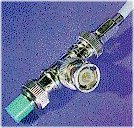
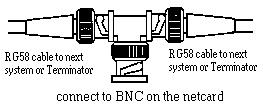
IL connettore a T deve essere collegato
direttamente al BNC della scheda di rete |
 |
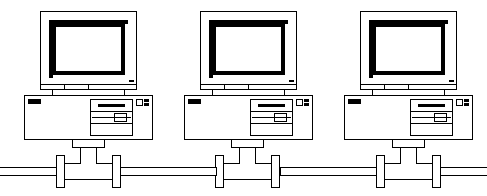
il collegamento del PC al centro della figura è errato |
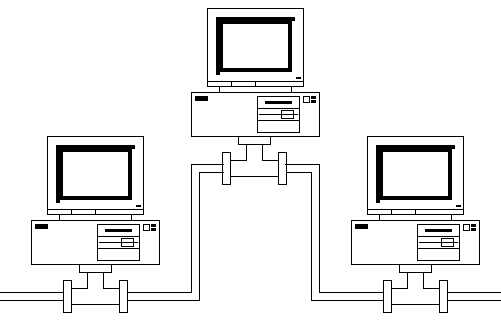 |
Collegamento giusto |
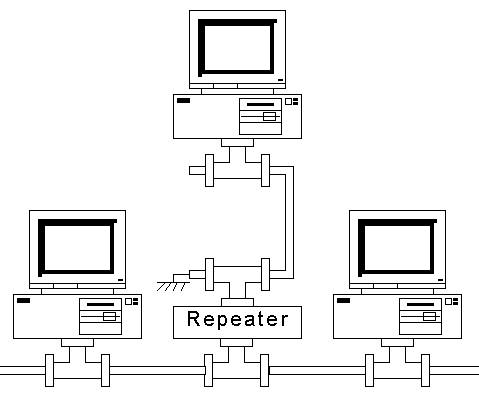 |
Sol "Repeater", which allows to connect the remote located system on its own segment, which need to have its own terminators. |
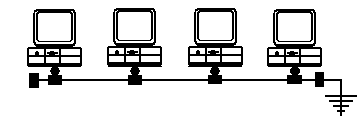
So, a more realistic view on an installation is:

The cable swings from system to system (it is NOT allowed to put in "junctions"
, to connect for example 3 PC's in a Y-configuration).
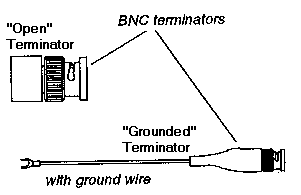
At the end of the cable, the coax-cable MUST be terminated, using a BNC 50 ohm terminator.
There are 2 different type of terminators:
Limitations:
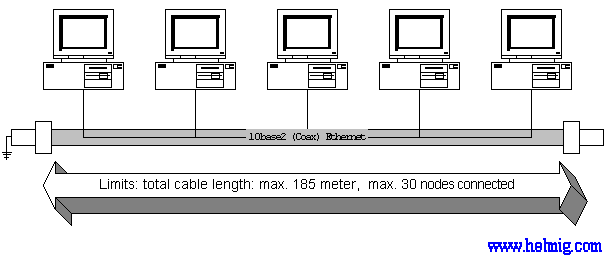
each connection to an Thin-Ethernet RG-58 cable is called a "node",
which can be a system like a PC, a UNIX-workstation or a Fileserver, but also
anything else connecting via a BNC-connector counts a a node (network printers,
repeaters,....).
- maximum 30 nodes on one Thin-Ethernet segment
- minimum 0.5 meter distance between nodes
- maximum total cable-length of 185 meter
If more than 30 nodes need to be connected or if the total cable-length needs to
be longer
than 185 meters, a repeater is the solution:

Multi-Segment network:
For each cable-segment, you need to be within the 10base2
limitation (max. 185 meter, 30 nodes), but this
box called "Repeater" connects now the
2 (or even more) segments (some Multi-port repeaters can
connect 4 or even 8 cables), which in view of the users extends
the cable-length beyond the 185 meters. More than 1 repeater can be used in a
network, but there are limits (see Large
Networks: 5-4-3 Rule). On very large networks,
it will be required to install Switches
to optimize network utilisation.